


Rewiring in Sheffield
IE Electricals carries out house rewiring across Sheffield and surrounding areas, from full rewires to partial rewiring of single rooms or circuits, with consumer unit upgrades included where needed, all in line with BS 7671. To discuss a rewire or request a quote, call IE Electricals on 07427 293958.
A rewire replaces the wiring in a property, either throughout the whole building or in specific rooms and circuits. IE Electricals carries out full and partial rewires across Sheffield and surrounding areas, on everything from older terraces to more recent housing that has outgrown its original wiring.
Deciding whether a property needs a full rewire, a partial rewire, or something short of either starts with a look at the existing installation. Age, condition and how the wiring has been altered over past tenancies all play a part in that decision.
Rewiring is disruptive work by nature, so planning matters as much as the wiring itself. IE Electricals talks through what each stage involves before booking anything in, so there are no surprises once work is under way.
Full rewire versus partial rewire
A full rewire replaces all the cabling and accessories throughout a property, normally including the consumer unit. It is the right approach when the existing wiring is old, has been altered piecemeal over the years, or no longer meets modern safety standards throughout the building.
A partial rewire replaces wiring and accessories in specific rooms or circuits only, for example a kitchen extension or a single floor, while leaving the rest of the existing installation in place. This suits properties where most of the wiring is sound but one area needs bringing up to standard.
Deciding between the two is not always obvious from the outside. A property can look fine room to room while the wiring behind the walls tells a different story, which is why the decision follows an inspection rather than a guess based on age alone. Where a partial rewire is chosen, the boundary between old and new wiring is agreed clearly, so both parts of the installation work safely together.
Signs a property may need rewiring
These are signs worth having checked, not a diagnosis on their own. A proper inspection, such as an EICR, confirms whether rewiring is actually needed rather than guessing from the symptoms alone.
- A consumer unit with a wooden back, cast iron switches, or an old rewireable fuse board
- Frequent tripping, flickering lights, or bulbs that need replacing often
- Cracked, scorched or warm sockets and switches, or a burning smell near an outlet
- Round pin sockets, or fabric or black rubber sheathed cabling
- Too few sockets in each room, or reliance on multiple extension leads
- No record of the property ever having been rewired
What the job involves
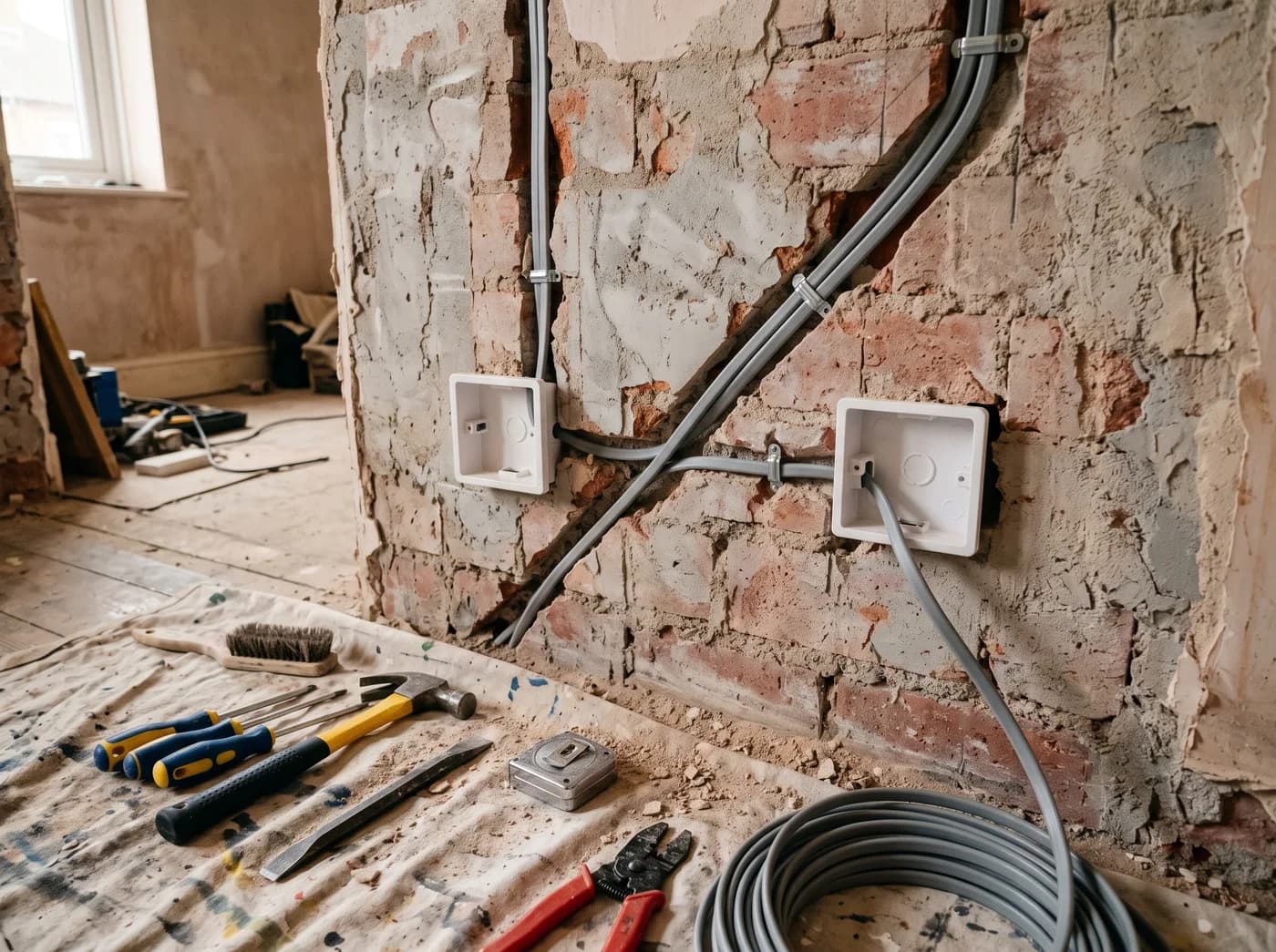
A rewire happens in two main stages. First fix is where old cabling is removed where needed and new cables are run through walls, floors and ceilings, chased in or clipped, ready to be connected. This stage happens before plastering and decorating, and is the most disruptive part of the job.
Second fix follows, once decorating is done. Sockets, switches, light fittings and the consumer unit are connected, tested and made live. Making good, patching plaster and leaving surfaces ready for redecoration, is agreed as part of the job so you know what is included and what is not.
Between first fix and second fix there is usually a gap for plastering and decorating, which is normally arranged separately. IE Electricals will talk through how that gap fits around the electrical stages so the whole project runs in a sensible order.
Full and partial house rewiring with consumer unit upgrades.
Disruption and planning
Rewiring means access to walls, floors and ceilings, so some disruption is unavoidable. Power is off to affected circuits while work is carried out, and rooms being rewired are generally unusable until second fix and making good are complete.
Planning ahead makes the biggest difference: agreeing which rooms are done first, whether you can stay in the property during the work, and what decorating is needed afterwards. This is worked through before the job starts, not discovered partway through.
For an occupied property, rewiring is often planned room by room or floor by floor, so at least part of the property stays usable. For an empty property between tenancies or during a wider renovation, the job can proceed without working around a resident, since access is not restricted.
The certificate you receive
A rewire, whether full or partial, is new installation work and is certified with an Electrical Installation Certificate (EIC). This confirms the completed wiring meets BS 7671 and is safe to use. A rewire is also typically notifiable under Part P, meaning it is certified through a competent person scheme or through building control.
Keep this certificate with your property paperwork. It is useful evidence of the work carried out, particularly if you come to sell the property or need to show what was done and when, and it gives a future EICR a clear reference point for the condition of the new wiring.
What affects the cost
Rewiring cost depends on several things rather than a single figure: the size of the property and the number of circuits involved, how easy the wiring is to access, the condition of the existing installation, and whether decoration is needed once the work is finished.
A property with easy access under floors and above ceilings is generally more straightforward and less disruptive to rewire than one where cables have to be chased into solid walls. Similarly, a property that already has a sensible number of circuits needs less new work than one that is being brought up to modern expectations from scratch.
A written quote follows a survey, once these factors are known for your property, so the figure you are given reflects the job in front of us rather than a general estimate.
What to send with an enquiry
- Whether you think a full or partial rewire is needed, or you are not sure
- The age of the property and any history of previous rewiring, if known
- Photos of the consumer unit and any sockets or switches that concern you
- Whether you need to stay in the property while work is carried out
- The best way and time to reach you
Related services
Frequently asked questions
How much does it cost to rewire a house?
Rewiring cost depends on the size of the property, the number of circuits, how accessible the wiring is, the condition of the existing installation and whether decoration is needed afterwards. A written quote follows a survey, so the figure reflects your property rather than a general estimate.
How long does a full house rewire take?
Duration depends on the size of the property, its access and condition, and how it is occupied during the work. There is no general figure: a realistic timescale is confirmed after a survey, once the scope is understood.
What are the signs a property might need rewiring?
Signs worth having checked include an old fuse board with a wooden back or cast iron switches, frequent tripping, flickering lights, warm or scorched sockets, round pin sockets, and too few sockets for how the room is used. These point to an inspection, not a certain diagnosis, so a proper check confirms whether rewiring is needed.
What happens on each day of a rewiring job?
First fix involves running new cables through walls, floors and ceilings before plastering and decorating. Second fix follows once decorating is done, connecting sockets, switches, lighting and the consumer unit, then testing everything before it is made live and signed off as complete.
What will I be given once the rewire is complete?
You receive an Electrical Installation Certificate, confirming the completed rewire meets BS 7671 and is safe to use. A rewire is typically notifiable work, so this certification is issued through a competent person scheme or through building control, and it is worth keeping with your property paperwork.
Which areas do you cover for rewiring work?
IE Electricals covers Sheffield and surrounding areas, including districts across the city and nearby towns, for full and partial rewiring. The same approach to planning and disruption applies wherever the property is. Get in touch to discuss your property and confirm coverage for your address.
How do I book a rewiring job?
Send an enquiry describing the property and what has led you to consider rewiring, or call IE Electricals on 07427 293958. A survey is arranged to look at the existing wiring before a written quote is given, so you know the cost before agreeing to anything.
Will a rewire need a certificate?
Yes. A rewire, whether full or partial, is certified with an Electrical Installation Certificate once complete, confirming the work meets BS 7671. This is issued as standard for rewiring work, alongside any notification required under Part P, and is worth keeping with the rest of your property records.
Is a full rewire notifiable work?
Yes, a full rewire is typically notifiable under Part P of the Building Regulations. This means the completed work is certified through a competent person scheme or through building control, rather than simply signed off privately, and the outcome is recorded on your Electrical Installation Certificate.
What should I send you when enquiring about a rewire?
Useful details are the age of the building, whether you are after a full rewire or only part of one, and pictures of the consumer unit plus any socket or switch that has been worrying you. Say too whether anyone will be living there while the work runs, and when you are easiest to reach.
Last updated:
Talk through a rewire
Send an enquiry with details of your property, or call IE Electricals on 07427 293958 to discuss a full or partial rewire.